REVIEW · HONG KONG SAR
Dark Side of Hong Kong – Kowloon Caged Homes Walking Tour
Book on Viator →Operated by Hong Kong Free Tours · Bookable on Viator
Hong Kong has a second skyline. This Kowloon walking tour pulls the curtain back on Hong Kong’s housing crisis, using real street scenes and pointed context. I love how it turns scary numbers into human-scale stories you can follow block by block.
I also like the guides’ delivery. People such as Alice and Isaac are praised for being clear, factual, and happy to answer questions at a good pace—so you’re not just watching signs and buildings, you’re learning how the system works.
One heads-up: you shouldn’t expect a fully hands-on look at occupied cage homes. What you see is education focused, including a viewing-style look inside a subdivided flat, so go for understanding first—not access.
In This Review
- Key things I’d pay attention to
- From Prince Edward to Sham Shui Po: the route that frames the story
- Cedar Street: the 500 sq ft puzzle, and why it hits hard
- Ki Lung Street and Lui Seng Chun: the causes, not just the symptoms
- Inside the 100 sq ft flat: what you will see (and what you won’t)
- Yee Kuk Street and Hai Tan Street: inequality you can compare side-by-side
- Pei Ho Street rooftop: the view that connects housing and survival
- Kweilin Street and SoCo: turning observations into solutions talk
- Guides make the difference: why these tours keep winning trust
- Price and value: what you’re paying for at about $33
- Who should book, and who might feel mismatched
- Should you book Dark Side of Hong Kong: Kowloon Caged Homes Walking Tour?
- FAQ
- Where does the tour start and end?
- What time does the tour begin?
- How long is the tour?
- What’s included in the price?
- Do I need hotel pickup or drop-off?
- Is the tour physically demanding?
- FAQ
- Does the tour allow service animals?
- Is this tour visit focused on real occupied cage homes?
Key things I’d pay attention to
- A stop-by-stop housing lesson that connects city policy to what people live with day to day
- Cedar Street’s space math (the 500 sq ft divided into five tiny units) made easy to grasp
- Guide Q&A you can actually use—questions are part of the experience, not an afterthought
- Street-level inequality in Sham Shui Po shown through backstreets and side-by-side housing types
- Real-life context, not poverty theater—it’s framed as urban planning and solutions
- A mix of outdoors and sheltered moments, helpful when the weather turns hot
From Prince Edward to Sham Shui Po: the route that frames the story
This tour is built as a walk with a purpose. It starts around Nathan Rd, Prince Edward and finishes in Sham Shui Po (the end point is near Sham Shui Po MTR). The timing is also key: it’s set for an 11:00 am start, and the total time is about 2 hours. That’s long enough to see the shift in neighborhoods, but not so long that you feel stuck on the pavement.
You’ll walk through parts of Kowloon that feel very Hong Kong: loud markets, narrow streets, and older building stock pressed up against newer development. The guides make sure you don’t just look—you also understand what you’re seeing and why it exists.
Group size stays small, with a maximum of 30 travelers. That matters because it makes the pace manageable and the Q&A more realistic. Bring a moderate level of walking comfort; the route includes some uphill moments (like the rooftop stop later), and you’ll be on your feet for most of the tour.
You can also read our reviews of more tours and experiences in Hong Kong SAR.

Cedar Street: the 500 sq ft puzzle, and why it hits hard
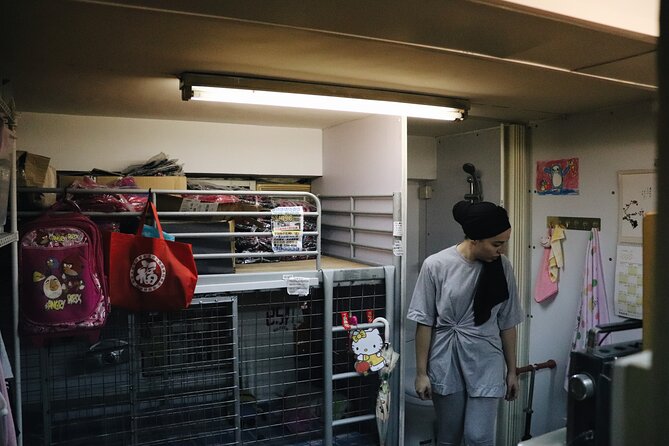
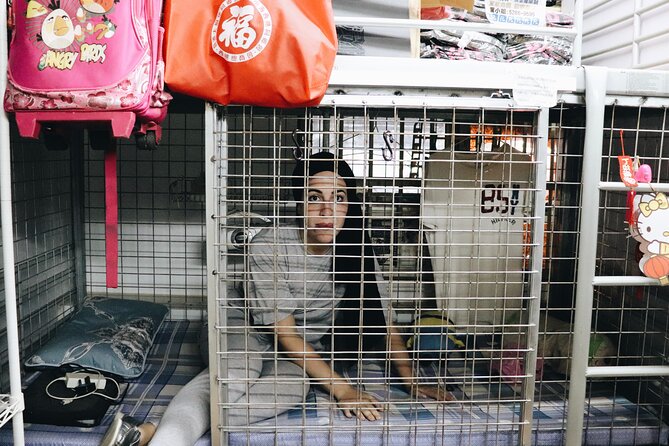
The Cedar Street segment is where the tour’s housing crisis lesson becomes concrete. The story goes right to the core: Hong Kong’s affordability squeeze is so extreme that a roughly 500 sq ft apartment can be subdivided into five around 100 sq ft units. That’s not just trivia. It explains why so many people end up in homes that feel more like storage than living space.
Then the tour brings you into the most important visual example. You’ll step through a 100 sq ft subdivided flat concept—where the kitchen, sleeping area, and living zone are arranged for the minimum-wage reality the guide describes. You also get shown a caged home concept for a single resident.
What I like here is the way the tour connects layout to daily life. It’s easy to say housing is expensive; it’s harder to understand what that expense does to breathing room, privacy, and even where a bed can realistically go. Cedar Street turns those abstractions into a mental picture you won’t forget.
Ki Lung Street and Lui Seng Chun: the causes, not just the symptoms
After the space math, the tour shifts gears into how Hong Kong got here. On Ki Lung Street, the explanation focuses on the combination of post-war population pressure, a low-tax economic model, and a scarce land supply. Those are big forces, but the guide keeps them grounded in how policy affects brick-and-mortar decisions.
Then at Lui Seng Chun, you hear a more personal angle. The guide shares a firsthand account of what it’s like to navigate housing in the world’s toughest property market. I value this part because it stops the tour from becoming only academic. You come away with both: the system and the lived experience inside it.
This is also one reason the tour tends to get high praise: guides don’t just recite facts, they answer follow-up questions. If you’re the type who wants context, this format is built for you.
Inside the 100 sq ft flat: what you will see (and what you won’t)
This part is the heart of the experience, and it’s worth calibrating your expectations. The tour includes an interior look at a subdivided unit set up as a viewing example—so you can understand how a working family might fit life into about 100 sq ft.
One review specifically called out that the unit shown can be a staged display rather than a truly occupied home. Another comment noted that the tour does not visit actual cage homes in a literal, inside-the-home way. That doesn’t make the tour less useful—it just changes what kind of experience it is.
So here’s the practical way to think about it: you’re getting an educational walkthrough designed to show the logic of subdivided housing, not a permission slip to walk into people’s private lives. If you go expecting to see someone’s actual home as if you’re dropping in, you may feel let down. If you go to understand urban planning realities and affordability mechanics, you’ll likely find it powerful.
If you’re a street photographer, this is also a good note: the tour pushes you to look closely at details that tell the story of crowded living.
Yee Kuk Street and Hai Tan Street: inequality you can compare side-by-side
The tour doesn’t stop at housing size. It also pushes into what life looks like in the surrounding social environment. At Yee Kuk Street, you hear about the illicit ties between the drug and sex trades in Sham Shui Po backstreets. This is handled as context, not sensational content—and it reframes the housing story as part of a wider pressure system affecting marginalized communities.
Then Hai Tan Street delivers one of the most visual contrasts on the route. The tour points out how brand-new apartments—mentioned as about USD $1.5 million—can stand side-by-side with dense clusters of subdivided units and caged homes. That pairing is the lesson in one glance: the city isn’t moving in one direction. It’s splitting.
I like that this tour doesn’t force you into one moral headline. It shows the mechanics: what happens when land is scarce, demand is high, and housing stays locked into a property-market logic. Once you see that contrast, Hong Kong’s skyline stops being just a view. It becomes part of the argument.



Pei Ho Street rooftop: the view that connects housing and survival
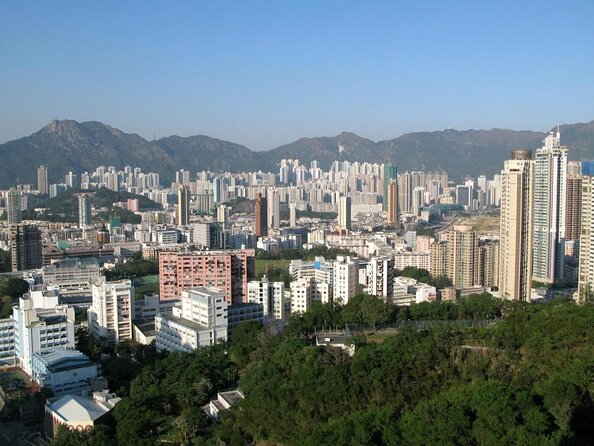
On Pei Ho Street, you ascend to a rooftop in central Sham Shui Po. From up there, you get a wider view of how rooftops function in neighborhoods like this—where building density and lack of space spill upward.
This stop is where I’d expect you to slow down mentally. The tour frames what you’re seeing as hidden slums and day-to-day survival realities that don’t make it onto postcards. From ground level, everything can feel like one busy street. From above, you understand the scale.
Even if you don’t love heights, this rooftop moment helps you understand why housing is described in terms of survival. It also helps you see how the neighborhood is layered—literally—with people using every inch available.
Kweilin Street and SoCo: turning observations into solutions talk
The final stop at Kweilin Street includes a visit to SoCo, a charity described as having 50 years of history advocating for marginalized people. The guide uses this time to talk about possible solutions for Hong Kong’s future.
I appreciate ending this way. When tours focus only on hardship, you can leave feeling stuck. Here, the tour’s last act nudges you toward systems thinking: what advocacy looks like, and what kinds of changes might reduce pressure instead of simply rearranging who gets squeezed.
It also gives the experience a more human arc. The city’s story becomes more than buildings. It becomes people working, organizing, and pushing for better outcomes.
Guides make the difference: why these tours keep winning trust
A big theme in the feedback around this tour is the guides. Names that come up again and again include Alice, Isaac, Grace Wu, Wind, Summer, Wing, and Michael. Beyond the names, the consistent praise is about style: clear explanations, a factual tone, and real patience with questions.
That matters because housing in Hong Kong can feel abstract until you see a layout and hear the cause-and-effect story. A good guide connects those dots fast, and keeps the group moving so you don’t lose the thread.
One more practical win: there’s mention that a chunk of the stops are in air-conditioned spaces. On a hot day, that can be the difference between enjoying the walk and feeling miserable while you try to absorb heavy material.
Price and value: what you’re paying for at about $33
At $32.82 per person for around 2 hours, this isn’t a luxury spend—and it’s not billed as a casual sightseeing loop either. The value comes from the structure: you pay for a guided narrative that connects housing policy, neighborhood geography, and the real constraints of living space.
If you’re the type who likes to know why a place is the way it is, the price makes sense. You get a local guide, multiple street stops, an interior viewing concept, a rooftop moment, and a charity visit—so you’re not paying just for walking routes and a few photos.
If, on the other hand, you’re mainly after postcard Hong Kong or one big highlight photo, you might feel the time is heavier than expected. This tour is meant to change how you understand the city.
Who should book, and who might feel mismatched
This is a great fit if you want:
- a housing crisis explanation anchored in what you can see on the ground
- a guide-led route through Prince Edward to Sham Shui Po that stays focused on causes and context
- an experience that’s tough to process but not judgmental or preachy
It may not be for you if:
- you want to enter truly occupied cage homes or private apartments (the tour is set up as an educational visit, not a private access experience)
- you prefer your tours light and upbeat, because the content centers on serious inequality
- you’re hoping for shopping or typical tourist stops
This is also worth considering for older teens and curious adults. One common theme is that people find it moving and thought-provoking without turning it into a spectacle.
Should you book Dark Side of Hong Kong: Kowloon Caged Homes Walking Tour?
I’d book it if your goal is to understand Hong Kong beyond the skyline shots. The route is short enough to stay manageable, but it still hits the points that matter: subdivided space, policy causes, neighborhood comparison, rooftop perspective, and a closing conversation with SoCo.
Just go in with the right expectation. You’re not buying entry to people’s homes. You’re buying a guided explanation that helps you read the city’s housing reality correctly.
If you’re sensitive to heavy topics, take care of yourself during the walk. There’s no requirement to force discomfort. But if you want a practical, honest look at how affordability shapes daily life in Sham Shui Po, this tour has a strong track record for reasons that go beyond hype.
FAQ
Where does the tour start and end?
It starts at Nathan Rd, Prince Edward, Hong Kong and ends in Sham Shui Po, Hong Kong (meeting and close by the Sham Shui Po MTR Station).
What time does the tour begin?
The start time is 11:00 am.
How long is the tour?
The duration is about 2 hours (approx.).
What’s included in the price?
A local guide is included. You should also expect the walking tour stops and the listed on-route experiences.
Do I need hotel pickup or drop-off?
No. Hotel pickup and drop-off are not included, so you’ll meet at the stated start point.
Is the tour physically demanding?
It requires a moderate physical fitness level. You’ll be walking and there’s at least one rooftop ascent as part of the route.
FAQ
Does the tour allow service animals?
Yes, service animals are allowed.
Is this tour visit focused on real occupied cage homes?
Based on what’s described in the available details, you should expect educational viewing rather than entering many truly occupied homes. One stop includes a subdivided flat viewing example, and the tour is not presented as visiting actual cage homes in the strict sense.