REVIEW · ASAKUSA
Asakusa Senso-ji Temple and Old Tokyo Walking Tour
Book on Viator →Operated by Localized Walking & Food Tours · Bookable on Viator
Senso-ji feels different when a guide explains it. This short walk through Asakusa helps you read what you’re seeing, from Kaminarimon to the prayer steps at Senso-ji.
I love that it stays small-group (max 12), so you can ask questions without shouting over everyone’s camera. You also get a solid slice of local street life beyond the big temple shots, including Hoppy Street and Shin Nakamise.
The only real catch: Asakusa is busy, so getting to the meeting spot on time matters, and expect tight lanes and lots of foot traffic.
In This Review
- Key highlights if you want the real Asakusa story
- Why Asakusa makes more sense with a guide
- Nakamise Shopping Street to Kaminarimon: the best way to start
- Entering Senso-ji: more than incense and selfies
- Asakusa Shrine (Sanja-sama): Shinto rules in plain steps
- Hoppy Street and Shin Nakamise: the shopping-culture side of Asakusa
- Azuma Bridge finish: the payoff view and what to do next
- Price and value: what $20 buys you in Tokyo terms
- Pace, meeting point, and weather reality
- Who should book this Asakusa walking tour
- Should you book this Asakusa tour?
- FAQ
- FAQ
- How long is the Asakusa Senso-ji Temple and Old Tokyo walking tour?
- What does the tour cost?
- How big is the group?
- Is this tour in English?
- What places are included on the walking route?
- Are admissions required at the main stops?
- What’s included in the price?
- What’s not included?
- Where does the tour start and end?
- What if the weather is bad?
- Is free cancellation available?
Key highlights if you want the real Asakusa story
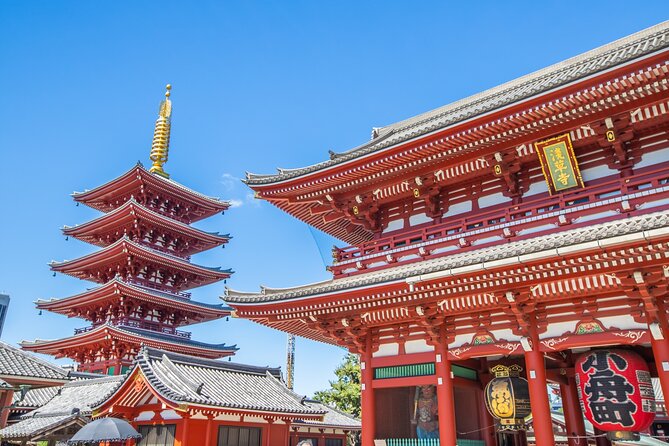
- Small-group pacing (max 12) keeps the explanations clear and questions actually answered
- How to pray at Buddhist and Shinto sites goes beyond point-and-photo basics
- Stall streets with a purpose: Nakamise and Shin Nakamise show you old trading lanes plus modern shopping
- Hoppy Street stop adds a very local nighttime-style atmosphere to the day
- Azuma Bridge finish gives you a practical way to transition from temple area to river views
Why Asakusa makes more sense with a guide
Asakusa can overwhelm fast. You’ll see massive gates, incense smoke, shiny souvenir rows, and people doing different rituals at once. A guide turns that visual chaos into something you can follow. You’re not just looking at Senso-ji and calling it done—you learn why certain actions matter and what people are trying to do when they pray.
This is also a smart format if your schedule is tight. The tour runs about 2 hours, stays on foot, and finishes in a place that feels like a natural next step. If you’re in Tokyo for the first time, it’s an efficient way to get your bearings in a neighborhood you’ll want to revisit later.
You can also read our reviews of more tours and experiences in Asakusa.
Nakamise Shopping Street to Kaminarimon: the best way to start
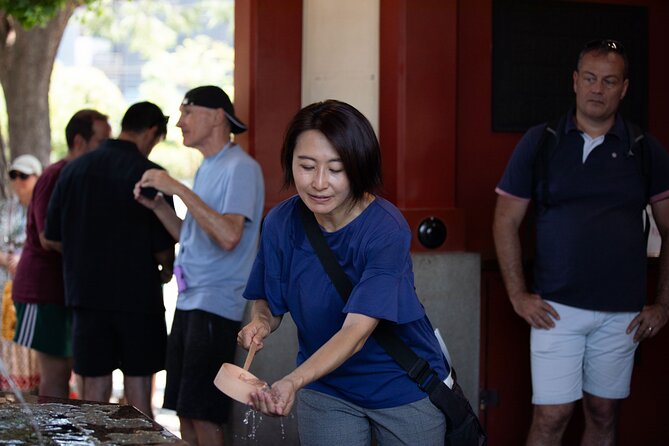
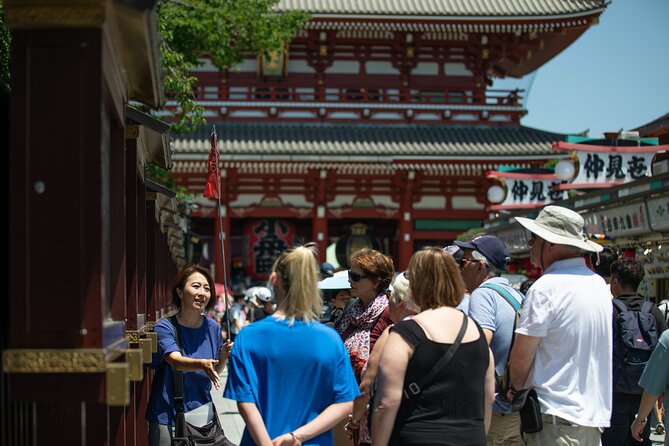
Your walk begins near Tokiwado Kaminari-okoshi Honpo, then heads toward the Kaminarimon area and Nakamise Shopping Street. This is the main approach to Senso-ji, lined with old-school shops and snack stalls. Even if you don’t plan to buy anything, the street is useful because it sets the scene: you’re moving from everyday shopping behavior into a sacred-site mindset.
Here’s what I like about starting here: it teaches you how Asakusa works as a layered place. You’re not walking through a theme park line—you’re crossing the boundary between commerce and ceremony. That helps you later when you’re standing at Senso-ji, watching people queue, rinse, bow, and photograph.
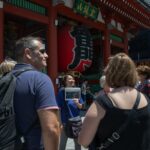
Practical note: Nakamise lanes get crowded quickly. If you’re sensitive to shoulder-to-shoulder walking, go in with calm expectations and keep moving with the group. Also, plan on being alert for the guide in the crowd. One of the most common “how do we find you?” moments in this area comes from showing up without a clear meeting-point anchor.
Entering Senso-ji: more than incense and selfies
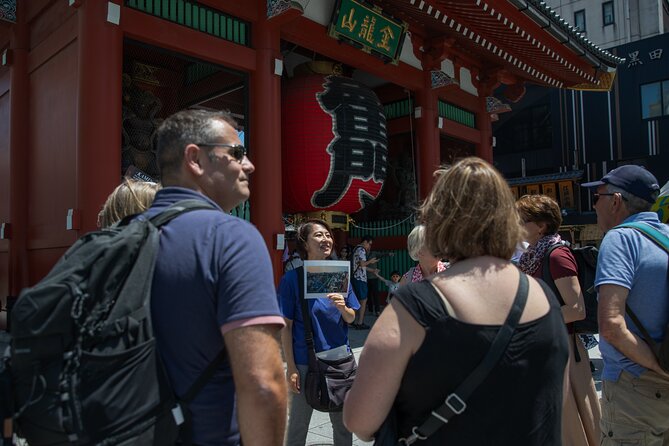
Senso-ji is the headline. The guide time here is what turns your visit from sightseeing into context.
You’ll hear stories about Senso-ji’s history and its role in shaping Asakusa’s identity. That matters because so much of what you see—temple layout, the rhythm of visitors, even the intensity of the atmosphere—makes more sense when you know why this place became such a center.
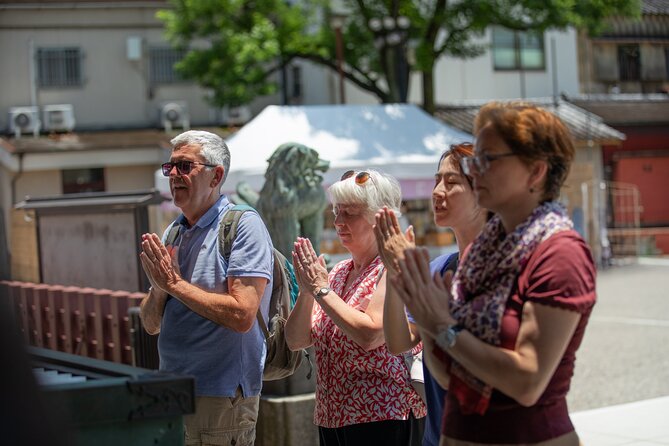
The most helpful part is the practical, hands-on orientation to customs. You’ll get shown how to participate respectfully, including guidance on prayer at a Buddhist site. In past groups, guides have even walked people through steps like purification behavior and how to take part in practices such as drawing fortunes. You also get that “okay, I get it” effect when you watch others perform rituals and then understand what’s happening.
And yes, the photo opportunities are real. More than one guide has pointed out a vantage point for photos overlooking the whole temple area. One guide even took photos for everyone, which is a big deal if you’re traveling solo or you just don’t want to play camera-on-a-stick roulette.
Asakusa Shrine (Sanja-sama): Shinto rules in plain steps
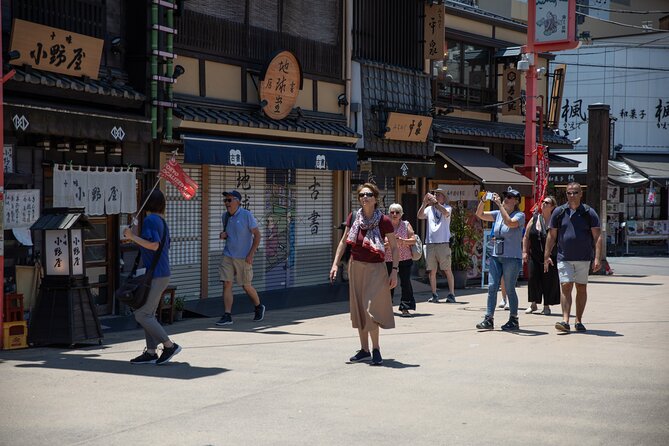
Right near Senso-ji is Asakusa Shrine, also known as Sanja-sama. The tour treats this as more than an add-on. It’s a different spiritual system, and the guide helps you notice that difference instead of treating it as just another gate-and-roof stop.
You’ll learn what the shrine honors and why it sits beside Senso-ji. That proximity can confuse people at first, because you’ll feel like you’re seeing the same religious “style” twice. You’re not. Shinto and Buddhism share space in Japan, but they don’t operate the same way, and your experience changes once you understand that.
Another detail I value here: the tour doesn’t assume you already know etiquette. You get guidance for how to behave at the shrine so you don’t accidentally do the opposite of what you intend. That’s especially important in a crowded setting where it’s easy to copy what the person ahead of you is doing without understanding why.
Hoppy Street and Shin Nakamise: the shopping-culture side of Asakusa
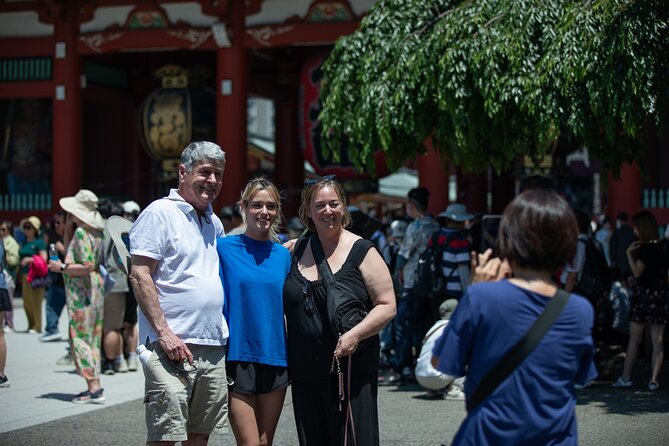
After the temple-and-shrine core, you’ll shift tone. Hoppy Street is known for its izakaya energy and the drink called hoppy. Even during daylight hours, the street has that “this is where people come to relax” feeling, and it gives your tour balance. You’re not only learning about religion—you’re also learning how locals hang out nearby.
Then you’ll add Shin Nakamise, described as an extension of Nakamise with a more modern touch. Think of it as the place where old traditions and newer shopping tastes sit side by side. The mix of contemporary boutiques alongside the older shopping approach helps you understand what Asakusa is today, not just what it was centuries ago.
A smart move for you here is to keep your eyes open for what looks like it matches your trip style. If you want souvenirs, this stretch tends to work well. If you prefer snacks, it’s a good area to plan a second pass after the tour, so you can shop without feeling rushed.

Azuma Bridge finish: the payoff view and what to do next
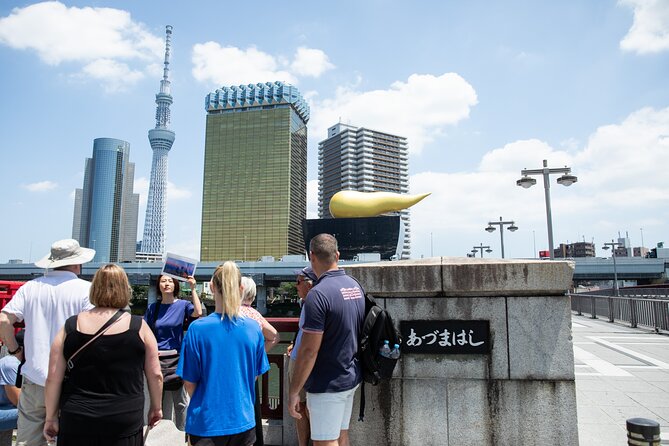
The tour ends at Azuma Bridge, spanning the Sumida River. This stop is useful because it turns your morning or afternoon walking loop into a real transition point. You get a river perspective and skyline views, including Tokyo Skytree in the distance. You’ll also be close to the Asahi Beer Hall area, so it’s a natural place to decide what comes next.
Why finish here? Because temples and shrines can pull your attention inward. Azuma Bridge pushes you back outward. Even if you only spend a few minutes looking around, it helps your brain map Asakusa relative to the rest of Tokyo.
If you want an easy follow-up plan: use the end point as your launching pad for a slower stroll along the river or for getting yourself oriented before dinner. The tour’s timing (about two hours total) makes this finish feel well-timed rather than abrupt.
Price and value: what $20 buys you in Tokyo terms
At $20 per person for about 2 hours on foot, the value comes from the combo of guide-led context plus an efficient route. Admission fees for the major stops are listed as free in the tour schedule, so you’re mainly paying for the human part: the explanations, the customs guidance, and the ability to ask questions.
The small-group size (max 12) is a key part of that value. If you’ve ever tried to learn temple etiquette on your own, you know how much time gets wasted figuring out what you’re allowed to do and what the lines are for. Here, you get that clarity fast, and it shows up in details like learning how to purify, how to approach prayers properly, and how shrine and temple customs differ.
I also like that the tour includes cultural and historical commentary throughout, not only at the big-ticket monuments. You’ll spend enough time at each place to absorb it, without the schedule turning into a hurry-up-and-run.
Pace, meeting point, and weather reality
The route is walk-based, with multiple short stops. That’s great for most people because you’re not dealing with long transfers. But you are dealing with city foot traffic, stairs and uneven surfaces at temple edges, and frequent turns through narrow lanes.
Meeting can be the trick in Asakusa. The start point is at Tokiwado Kaminari-okoshi Honpo (1-chome-3-2, Asakusa). In a crowd, that means you should arrive a few minutes early, check the map, and use the store location as your anchor. Once you see other group members gathering, stick close—this is one of the easiest tours to miss if you’re ten minutes late and trying to find people by guesswork.
Also remember the tour requires good weather. If conditions are poor, you’ll be offered a different date or a full refund. Since this is an outdoor walking experience, it’s smart to treat forecasts as part of your planning.
Who should book this Asakusa walking tour
This is a strong fit if:
- You’re a first-time Tokyo visitor and want a fast orientation in Asakusa
- You’d rather learn temple and shrine etiquette from an English-speaking local guide than from trial and error
- You want a small-group experience where your questions get answered
- You like street-level culture as much as landmark sightseeing (Nakamise, Shin Nakamise, and Hoppy Street matter here)
If you already know a lot about Buddhism and Shinto, you might still enjoy the practical etiquette walkthrough and the street route. But the biggest benefit is for people who want context they can use immediately while they’re standing in the sacred space.
Should you book this Asakusa tour?
Yes, if you want your Senso-ji visit to make sense fast and you don’t want to spend time figuring out etiquette on your own. The best reason to book is the way the guide connects history to action—how to pray, how rituals work, and what to look for beyond the main gate. Add in Hoppy Street and Shin Nakamise, and you get a fuller Asakusa snapshot in about two hours.
Skip it if you want a totally independent, no-structure wander with zero group time. This tour is built around walking together and learning together, and it works best when you’re okay staying with the group pace.
FAQ
FAQ
How long is the Asakusa Senso-ji Temple and Old Tokyo walking tour?
The tour lasts about 2 hours.
What does the tour cost?
It costs $20.00 per person.
How big is the group?
It’s a small-group tour with a maximum of 12 participants.
Is this tour in English?
Yes. It includes an English-speaking local guide.
What places are included on the walking route?
The tour includes Nakamise Shopping Street (Kaminarimon), Senso-ji Temple, Asakusa Shrine, Hoppy Street, Shin Nakamise, and Azuma Bridge.
Are admissions required at the main stops?
The schedule lists admission ticket free at the stops (including Nakamise Shopping Street, Senso-ji Temple, and Asakusa Shrine).
What’s included in the price?
The tour includes the English-speaking local guide, the guided walking tour of the Asakusa area (including Senso-ji and Nakamise), and cultural and historical commentary.
What’s not included?
Food, drinks, and personal expenses are not included. Transportation to and from the meeting point is also not included, and gratuities are optional. Travel and health insurance are not included.
Where does the tour start and end?
It starts at Tokiwado Kaminari-okoshi Honpo, 1-chōme-3-2 Asakusa, Taito City, Tokyo, and it ends near Azuma Bridge at 2-chōme-1-16 Kaminarimon, Taito City, Tokyo.
What if the weather is bad?
The experience requires good weather. If it’s canceled due to poor weather, you’ll be offered a different date or a full refund.
Is free cancellation available?
Yes. You can cancel up to 24 hours in advance for a full refund. If you cancel less than 24 hours before the start time, the amount you paid will not be refunded.