REVIEW · NEW DELHI
Private Golden Triangle Tour Delhi Agra Jaipur ( Top Rated )
Book on Viator →Operated by AR INDIA TOUR · Bookable on Viator
Sunrise at the Taj sets the tone. This private Golden Triangle tour links Delhi, Agra, and Jaipur with door-to-door A/C transfers and a personal guide who makes each stop make sense, not just feel like a checklist.
What I like most is the timing—especially the early Taj Mahal sunrise—and the way the day is paced so you’re not sprinting from place to place. One possible drawback to plan for: admission tickets are not included for several big sights, so you’ll want to budget for entry fees on top of the tour price.
In This Review
- Key points that matter before you go
- The Golden Triangle in 3 days: a smart shortcut through India
- Where you start in Delhi: meeting at Sunehri Masjid
- Day 1 in Delhi: Qutub Minar, Lotus Temple, spice market, Jama Masjid, India Gate
- Qutub Minar: the tall landmark you’ll spot from the start
- Lotus Temple: open to everyone, easy to admire
- Khari Baoli: shopping streets, not museum browsing
- Jama Masjid: big courtyard energy in 30 minutes
- India Gate + Parliament House + Rashtrapati Bhavan: the grand government axis
- Day 2 in Agra: Taj Mahal sunrise, Agra Fort, and Baby Taj
- Taj Mahal at sunrise: where timing does the heavy lifting
- Agra Fort: Mughal power told through stone
- Itmad-ud-Daulah (Baby Taj): small scale, high detail
- Day 3 in Jaipur: step well, Jal Mahal, City Palace, Jantar Mantar, Hawa Mahal
- Panna Meena ka Kund: a step well that looks like a puzzle
- Jal Mahal: a palace-on-the-lake stop at Man Sagar
- City Palace: where the royal seat becomes a walkthrough
- Jantar Mantar: instruments for measuring the sky
- Hawa Mahal: the Palace of Breeze at street level
- The private guide factor: why it changes the whole trip
- What the $148 price really covers (and what you may still pay)
- Pacing and logistics: door-to-door comfort, but plan for early starts
- Who should book this Golden Triangle tour?
- Should you book this private Golden Triangle tour?
- FAQ
- How long is the private Golden Triangle tour?
- What is the starting meeting point in Delhi?
- Is this a private tour?
- Do I get pickup and drop-off?
- Is the Taj Mahal sunrise visit included?
- Are admission tickets included for monuments?
- What is the cancellation policy?
Key points that matter before you go
- Taj Mahal sunrise with guided time inside, plus a traditional breakfast after
- Door-to-door A/C transfers between Delhi, Agra, and Jaipur to cut logistics stress
- Delhi Old City + landmark day, from Qutub Minar to Jama Masjid and India Gate
- Agra stops built around Mughal monuments, including Agra Fort and Itmad-ud-Daulah (Baby Taj)
- Jaipur royal-era highlights, including City Palace, Jantar Mantar, and Hawa Mahal
- A guide you can lean on for photos and context, with frequent praise for guides like Kevin, Azeem, Basant, Azam, and Maahi
The Golden Triangle in 3 days: a smart shortcut through India
If you’re short on time, the Golden Triangle is the most efficient shape your itinerary can take: Delhi first, then Agra, then Jaipur. The value here is that you’re not building the puzzle yourself. Instead, you get a private setup with pickup, transportation handled, and a guide to keep you oriented while you move through a lot of major monuments.
For your money, you’re mostly paying for three things: (1) the smooth logistics of getting between cities, (2) the early start that makes the Taj Mahal experience better, and (3) real interpretation so you don’t just stand and stare. The tour runs about 3 days, and it’s typically booked around 20 days in advance, which is a clue that sunrise slots and driver availability can fill up.
The tour price is $148 per person, which is reasonable given that this is private (not a shared group day) and includes parking fees plus mobile ticketing. The one “watch this” item is admissions: several stops explicitly say admission ticket not included, so the total cost for your day can creep upward depending on what you pay for.
You can also read our reviews of more tours and experiences in New Delhi.



Where you start in Delhi: meeting at Sunehri Masjid
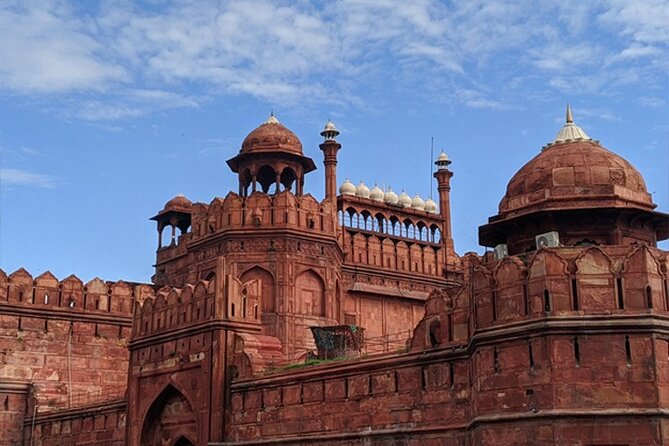
The experience starts at Sunehri Masjid in Old Delhi (Nishad Raj Marg, near Lal Qila). That’s a practical choice. Old Delhi is the best area to begin if you want the tour to feel grounded in real neighborhoods instead of only seeing government buildings and big-name squares.
Starting here also makes the first day’s theme click: you’re close to Old Delhi sights early, then you gradually work outward toward central Delhi landmarks. The schedule matters because Delhi’s traffic and distances can change your mood fast. A morning start plus a plan helps you avoid the classic problem: arriving late, missing the best photo angle, and then feeling rushed.
Day 1 in Delhi: Qutub Minar, Lotus Temple, spice market, Jama Masjid, India Gate
Day 1 is built as a “mix your moods” day. You get an UNESCO-listed tower, a modern faith landmark, a historic spice market, and then the giant ceremonial scale of Mughal-era Delhi and British-era war memorials.
Qutub Minar: the tall landmark you’ll spot from the start
Qutub Minar is a 73-meter, five-storey minaret at a UNESCO World Heritage site, tied to Delhi Sultanate founder Qutub-ud-din Aibak. Expect about an hour here. Admission is not included, so check what you’ll need to pay for when you arrive.
What I like about putting Qutub Minar first is the visual anchor. Once you’ve seen it, everything else in Delhi starts to look like part of a long timeline instead of random highlights.
Lotus Temple: open to everyone, easy to admire
The Lotus Temple is a free stop and takes about an hour. It’s famous for its flower-like design and is open for everyone, regardless of religion. If you want a break from crowds and old stone, this one gives you clean lines and calm.






Khari Baoli: shopping streets, not museum browsing
Khari Baoli is a historic spice market in Old Delhi. It’s free and scheduled for about 45 minutes. Even if you don’t buy anything, it’s useful because it gives you a taste of how people actually live and trade here.
Jama Masjid: big courtyard energy in 30 minutes
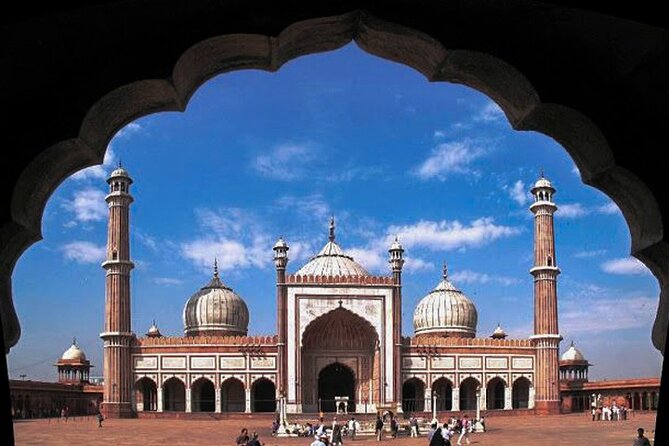
Jama Masjid is commissioned by Emperor Shah Jahan and runs for about 30 minutes on this tour. Admission is not included. The key thing to know: this is a stop where your time gets used for orientation—architecture, scale, and what you’re looking at—rather than a long wandering session.
India Gate + Parliament House + Rashtrapati Bhavan: the grand government axis
Then you shift gears. India Gate is free and scheduled for 1 hour 45 minutes. After that you get short stops at Parliament House (free, about 15 minutes) and Rashtrapati Bhavan (free, about 15 minutes). These are more about the perspective: you see how Delhi looks as a capital city, not just a historic one.
My takeaway for Day 1: you’ll end the day feeling like you saw both Delhi’s old spine and its official, ceremonial face. The only consideration is that Day 1 is dense. If you’re the type who needs long sits or slow shopping, you may feel the pace.
Day 2 in Agra: Taj Mahal sunrise, Agra Fort, and Baby Taj
Agra is where your trip stops being about variety and starts being about impact. The schedule gives you the crown jewel on purpose: Taj Mahal sunrise.
Taj Mahal at sunrise: where timing does the heavy lifting
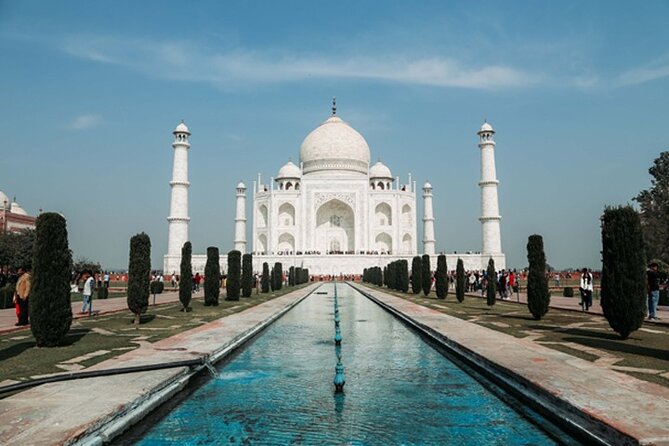
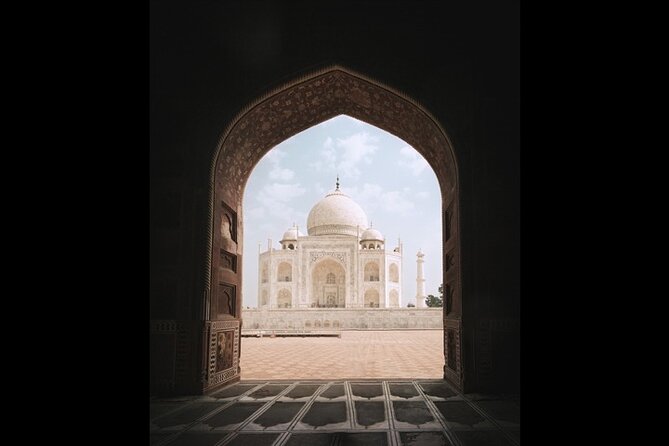
The Taj Mahal stop runs about 3 hours, with sunrise viewing and a private guided tour inside. Admission is not included, but the guide time is part of what you’re paying for. Afterward, you’ll have breakfast at a local cafe.
This is the day’s big decision point, and it’s why sunrise matters. At early light, the marble look changes fast, and you’re more likely to get the kind of photos that don’t feel like you’re fighting crowds. Also, the guided inside visit helps you connect what you see to what it was meant to do.
Agra Fort: Mughal power told through stone
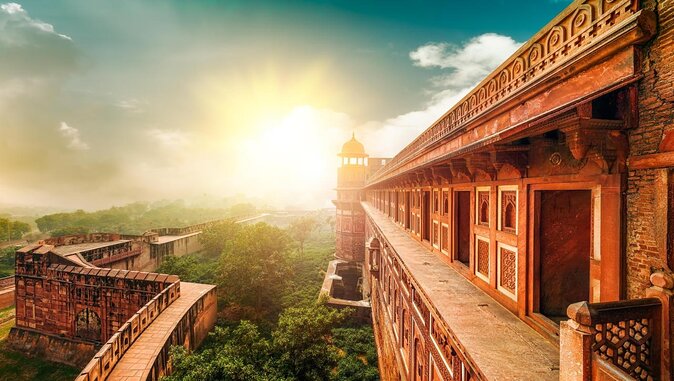
Next is Agra Fort, about 1 hour. Admission is not included. Your guide’s job here is to translate the layout—palaces, balconies, and gardens—into something understandable without you needing to study an architecture book first.
A practical note: this stop is shorter than the Taj, so ask your guide where to stand for the best angles. Guides who treat photography like a skill (not an accident) are a big plus here.
Itmad-ud-Daulah (Baby Taj): small scale, high detail
Itmad-ud-Daulah is scheduled for about 2 hours and is often called Baby Taj or the jewel box. It’s also described as a precursor to the Taj Mahal, which is exactly why this stop works on a second day. Admission is not included.
This monument tends to reward slow attention: the more you can focus on details, the more it clicks. If you’re moving quickly through the Golden Triangle, this is the stop that helps you slow down without losing momentum.
My takeaway for Day 2: you’ll feel the sweep of Mughal grandeur—first the iconic symbol, then the fortified complex, then the quieter, detail-driven mausoleum.
Day 3 in Jaipur: step well, Jal Mahal, City Palace, Jantar Mantar, Hawa Mahal
Jaipur is where the trip feels decorative and planned. The day is mostly monuments that explain themselves visually, which is nice after two long “big effort” days.
Panna Meena ka Kund: a step well that looks like a puzzle
Panna Meena ka Kund is a step well, about 30 minutes, and free. It’s the kind of place where the value is partly in the geometry: you’re looking at something functional that’s also designed.
Jal Mahal: a palace-on-the-lake stop at Man Sagar
Jal Mahal is free and scheduled for about 2 hours. It’s described as a palace that appears to float on Man Sagar Lake. This is a good pause between heavier monuments because it gives you space to breathe and watch the water-facing views.
City Palace: where the royal seat becomes a walkthrough
City Palace runs about 1 hour 30 minutes, and admission is not included. This is the administrative and ceremonial seat of the Maharaja of Jaipur, so you’ll want your guide to explain how the rooms and spaces were used—not just what everything is called.
Jantar Mantar: instruments for measuring the sky
Jantar Mantar is a UNESCO World Heritage site built in 1734. It takes about 1 hour, and admission is not included. If you like science-with-a-story, this stop is a standout because the structures are built for observation.
Hawa Mahal: the Palace of Breeze at street level
Finally, Hawa Mahal (Palace of Wind) is about 1 hour. Admission is not included. It’s tied to the Tripolia Bazaar area near City Palace, and the stop is set up so you see it as part of the Pink City streets, not as a remote landmark.
My takeaway for Day 3: Jaipur here is practical beauty. You’ll see monuments that are easy to “get,” even if you don’t know every term ahead of time.
The private guide factor: why it changes the whole trip
This tour leans hard on the guide. That’s not a small detail—it’s the difference between watching India go by and understanding what you’re actually looking at.
In the feedback I’ve seen, guides like Kevin, Azeem, Basant, Azam, and Maahi get praised for staying friendly, weaving history with humor, and helping with photos. That last part matters. If you’re traveling as a couple or planning honeymoon photos, it’s a real quality-of-life thing to have someone who knows how to position you and keep moments from turning into awkward, rushed selfies.
If you want the trip to feel less like a checklist, use your guide early. Ask a simple question at the first stop: What should I notice first here? That usually unlocks the rest of the day.
What the $148 price really covers (and what you may still pay)
At $148 per person for about 3 days, you’re buying a private, transportation-heavy route that includes:
- pickup and door-to-door A/C transfers
- parking fees
- mobile ticketing
- breakfast on Days 2 and 3 if you select the hotel option (breakfast otherwise isn’t included as part of the base)
On top of that, the itinerary includes several free stops (like Lotus Temple, Khari Baoli, India Gate, Parliament House, Rashtrapati Bhavan, Panna Meena ka Kund, and Jal Mahal), but it also lists admission ticket not included for major monuments (like Qutub Minar, Jama Masjid, Taj Mahal, Agra Fort, Itmad-ud-Daula, City Palace, Jantar Mantar, and Hawa Mahal).
So the value calculation is simple for you:
- If you’re willing to budget for monument entries, the price feels like good service value.
- If you were hoping everything would be fully included, you’ll want to plan for extra fees.
A smart approach: ask your guide what you’re paying for on arrival day by day, then decide on the spot how much time you want to spend at each paid stop.
Pacing and logistics: door-to-door comfort, but plan for early starts
The big logistical win is that you get an air-conditioned vehicle for the duration of the tour and door-to-door transfers. That reduces the headache of hiring multiple rides, figuring out meeting points, or losing time to transit decisions.
The tradeoff is that you’ll still have travel days between Delhi, Agra, and Jaipur. That means you should pack for long stretches, and you should treat sunrise as non-negotiable—your day in Agra is built around it. If you’re not a morning person, I’d rather you know that now than after you’ve agreed to the plan.
Who should book this Golden Triangle tour?
This private Golden Triangle tour is a strong fit if:
- you want Taj Mahal sunrise with a guided interior visit
- you prefer private logistics over shared group schedules
- you value having a guide who can explain monuments and help with photos
- you like seeing big-name sights without doing all the planning yourself
It may be less ideal if:
- you dislike early mornings and tight monument timing
- you want a fully all-inclusive price with zero extra entries at paid stops
- you’re hoping for long, unstructured wandering time at every site
Should you book this private Golden Triangle tour?
Yes, if you want a high-impact route with fewer moving parts. The combination of sunrise timing at the Taj, a personal guide for context, and door-to-door A/C transfers makes this one of the more practical ways to do Delhi–Agra–Jaipur in a short window.
Book with confidence if you’re willing to handle entrance fees as part of your budget. If you want hotel nights and breakfast, choose the option that includes accommodation and breakfast for Days 2 and 3—this tour specifically calls that out as an add-on.
One last decision helper: if photos matter to you, tell your guide early. The people behind this experience have been praised for their photo skills, which means you’ll likely leave with more than just the usual blurry monument shots.
FAQ
How long is the private Golden Triangle tour?
It runs for 3 days on average.
What is the starting meeting point in Delhi?
The tour starts at Sunehri Masjid, Nishad Raj Marg, Lal Qila, Old Delhi, New Delhi, Delhi.
Is this a private tour?
Yes. It is private, and only your group participates.
Do I get pickup and drop-off?
The experience includes pickup offered, and it ends back at the meeting point.
Is the Taj Mahal sunrise visit included?
Yes. Day 2 includes Taj Mahal sunrise with a private guided tour inside.
Are admission tickets included for monuments?
Not always. Several stops list admission tickets as not included, while others are listed as free.
What is the cancellation policy?
Free cancellation is available up to 24 hours in advance for a full refund. If you cancel less than 24 hours before the start time, the amount paid is not refunded.