REVIEW · NEW DELHI
Private Old and New Delhi City Full Day or Half Day Tour
Book on Viator →Operated by Markable Joy · Bookable on Viator
Delhi is loud, hot, and full of stories. This tour gives you a private car for the long stretches and a tuk-tuk moment for the Old Delhi feel, all guided end to end.
I especially like the mix of major sights across eras, from Jama Masjid and Red Fort in Old Delhi to Humayun’s Tomb, Qutub Minar, and the Lotus Temple in New Delhi. I also like how logistics are handled for you: round-trip hotel pickup, a chauffeur-driven car, and a guide who keeps the day moving at a pace that works for your group.
One drawback to plan for: parts of the day can shift with traffic and timing, and the tuk-tuk ride in Old Delhi may be an extra cost since it’s listed as not included—so confirm what’s covered before you go.
In This Review
- Key things to notice before you book
- Price and logistics: what you actually get for the money
- Private car plus Old Delhi tuk-tuk: a smart way to handle traffic
- Old Delhi start: Jama Masjid and the scale of Mughal Delhi
- Red Fort: power, style, and what the walls still communicate
- Chandni Chowk spices: shopping with senses, not chaos
- India Gate and the short pause: a World War memorial moment
- Gurudwara Bangla Sahib: water, faith, and a place to slow down
- New Delhi drives and viewpoints: President’s House and Parliament House passes
- Humayun’s Tomb and Akshardham swap: UNESCO gardens and a schedule reality
- Swaminarayan Akshardham: a modern temple that still feels ancient
- Qutub Minar: tall minaret, UNESCO context, and a strong finish
- Raj Ghat (optional): Gandhi’s memorial as a short pause
- Lotus Temple: the last stop that often feels like a reset
- Driver and guide quality: what you can hope for (and what to watch)
- Small comforts that actually matter in Delhi heat
- Should you book this Old and New Delhi tour?
- FAQ
- Is pickup from my Delhi hotel included?
- How long is the tour?
- Is this tour private or shared?
- Are entrance tickets to monuments included?
- Is the tuk-tuk ride in Old Delhi included?
- What happens if I visit on a Monday?
- Do I need to bring ID?
Key things to notice before you book

- Hotel pickup + chauffeur car means less stress in Delhi traffic, more time looking at monuments.
- Old Delhi by tuk-tuk helps you experience the market lanes up close instead of just watching from a vehicle window.
- Entrance tickets can be included or not depending on the option you choose, so check what’s covered for you.
- A private guide lets you ask questions and adjust pacing, especially if you want more photo stops or a slower walk.
- Akshardham timing matters: it’s closed on Mondays, so your day switches to Humayun’s Tomb instead.
- Bring a photo ID since it’s needed for monument checks.
Price and logistics: what you actually get for the money
At about $21.43 per person for an ~8-hour day, this is priced like a budget-friendly way to see a lot of Delhi without wrestling with maps, app-based navigation, or packed public transport. The value gets even better because it’s set up as a private tour for your group (so you’re not squeezed around strangers), with hotel pickup and drop-off included.
That said, Delhi can punish sloppy planning. The key practical detail is that your day depends on timing and traffic, and the order can be adjusted. You’ll want to keep a little flexibility in your schedule—especially if you have dinner reservations or a train later the same evening.
Also, the cost listing suggests a typical “choose-your-option” setup:
- Monument tickets may be included if you select the option with entrance fees.
- Meals are not included.
- The tuk-tuk ride in Old Delhi is listed as not included, even though it’s part of the experience described.
So, think of the base price as covering the guided routing, private chauffeured transportation, and many built-in comforts (like umbrellas and water). Your total day cost may rise slightly if you opt into more ticketing or if you pay for the tuk-tuk segment separately.
You can also read our reviews of more tours and experiences in New Delhi.



Private car plus Old Delhi tuk-tuk: a smart way to handle traffic
Delhi traffic is real. This tour’s biggest win is that you don’t spend the whole day fighting it. You start with a pickup from your hotel, then you’re in an air-conditioned car with a chauffeur, which helps on the long drives between Old Delhi and New Delhi.
Then you switch modes in Old Delhi to a tuk-tuk. That changes the experience in a useful way: the goal isn’t comfort. It’s getting close to street life and market energy, while still having a guide who can steer you through what’s worth your time.
In the real world, the tuk-tuk portion can feel like a mini-adventure. If you hate loud traffic noise or you’re sensitive to exhaust, consider bringing a mask and keep expectations realistic. But if you want the “I’m in the market right now” feeling, this is the part people tend to remember.
Old Delhi start: Jama Masjid and the scale of Mughal Delhi
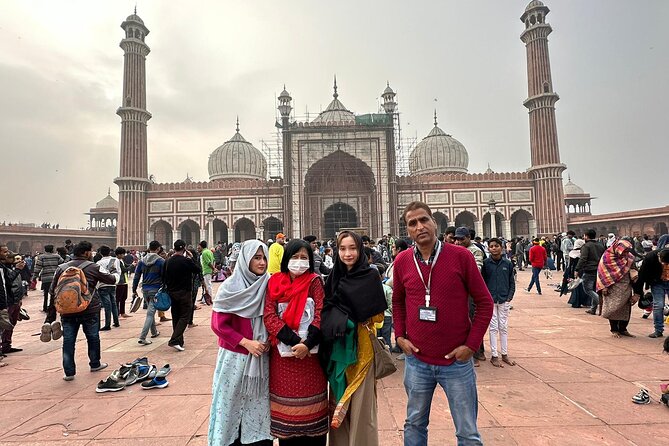
You begin with Jama Masjid, described as India’s largest mosque. Plan to take your time in the courtyard area and absorb the scale of the place, which was built in 1656 with help from 5,000 workers. Even if your focus is photography, it’s worth slowing down here because it sets the tone for everything you’ll see after.
What I like about starting at Jama Masjid in a guided format: you’re not just looking at architecture. You’re learning how this site fits into the larger story of Old Delhi, before you head into the more chaotic lanes nearby.
A consideration: crowds can be intense at major religious sites. If your guide times it well, you’ll have a smoother experience. If timing slips, expect more waiting and more people-in-your-shot moments.
Red Fort: power, style, and what the walls still communicate
Next comes the Red Fort, tied to Shah Jahan and built between 1639 and 1648. This was a main Mughal residence, and the fort’s Indo-Islamic and Mughal architectural style shows you how Delhi’s rulers blended influences into a look that’s still recognizable.
The practical value here is that you’re not just checking a famous building off a list. You’re getting a lens for the city: walls, gatekeeping, court life, and the idea of power expressed through stone.
Time is usually tight on days like this, so treat Red Fort as a “see the big picture fast” stop. If you want deeper exploring inside, ask your guide whether you can extend the time or prioritize specific views.
Chandni Chowk spices: shopping with senses, not chaos
Then you reach Chandni Chowk, known here specifically for spice shopping. This is one of those places where your guide can change the whole experience. With someone who knows what to look for, you’re more likely to buy something you’ll actually use, rather than getting carried away by the biggest pile in the stall.
Chandni Chowk is also a sensory workout: color, smell, and constant movement. Even if you don’t buy much, it’s a great place to pause and understand how spices are used and sold in daily life.
If you’re shopping, here’s my practical advice: decide your budget before you start walking. Spices are easy to love, and markets are designed to keep you looking.






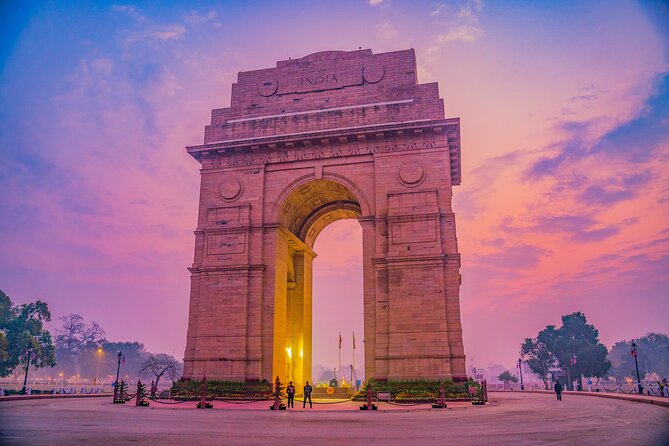
India Gate and the short pause: a World War memorial moment
Next stop is India Gate, with a quick visit (about 15 minutes) that centers on the 1921 Tomb of the Unknown Soldier. The key detail is the names of 13,300 Indian army servicemen carved on the wall who died during the First World War.
This stop can feel brief, but it gives your day a different emotional note between the heavyweight Mughal sights of Old Delhi and the more modern monuments ahead.
If you want a calm photo moment, India Gate can work well. Just don’t expect it to replace longer sightseeing time elsewhere.
Gurudwara Bangla Sahib: water, faith, and a place to slow down
You’ll then visit Gurudwara Bangla Sahib, with about 30 minutes. The story shared around this site includes a visit by the eighth Sikh Guru in 1664, when people affected by a smallpox and cholera epidemic were cared for using water from a tank associated with the temple.
It’s a good contrast stop: you’ve been in market noise and fort scale, and now you get a steadier rhythm and a strong sense of community space.
My tip: treat this as a reset. If your earlier walking felt rushed, use this stop to sit, observe, and take photos without rushing.
New Delhi drives and viewpoints: President’s House and Parliament House passes
As the day moves toward the New Delhi side, you’ll drive past President’s House and later Parliament House, with time primarily for pictures. These are not meant to be long museum-style stops in this itinerary—more like visual bookmarks.
This is a practical choice in a full-day plan: you get the recognition factor (this is what the buildings are), while still keeping momentum for the major monuments later.
Humayun’s Tomb and Akshardham swap: UNESCO gardens and a schedule reality
The itinerary includes Humayun’s Tomb (with about 30 minutes), described as a UNESCO World Heritage Site and noted as the first garden tomb of India. It’s connected to the story of Humayun’s wife building the tomb after his death.
You’ll also have Swaminarayan Akshardham on many days, but there’s an important scheduling rule: Akshardham is closed on Monday, so you’ll be taken to Humayun’s Tomb instead.
That swap matters more than it sounds. If you’re visiting on a Monday and you were hoping for Akshardham, you’ll want to adjust your expectations and focus on the UNESCO stop as your highlight for that portion of the day.
Swaminarayan Akshardham: a modern temple that still feels ancient
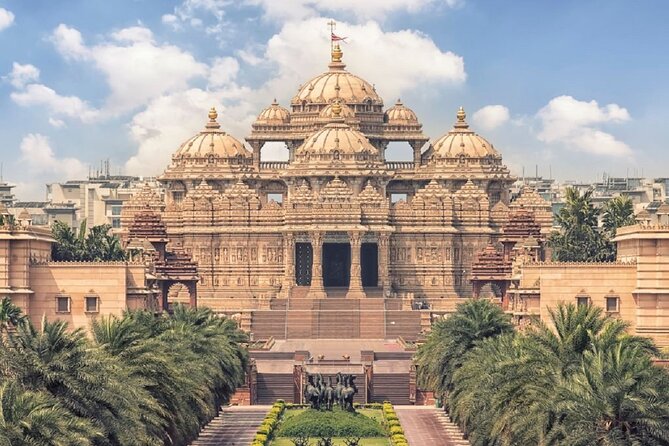
When it is open, Swaminarayan Akshardham gets about 30 minutes in this plan. It’s described as one of the biggest Hindu temples, constructed in 2005, yet with architecture that gives it an older feel.
Because you’re short on time, focus on the exterior impact and the main visual areas your guide points out. If you want a slower, deeper temple visit, this isn’t the itinerary that does that well—but it’s effective for getting oriented and seeing why the site is such a major attraction.
Qutub Minar: tall minaret, UNESCO context, and a strong finish
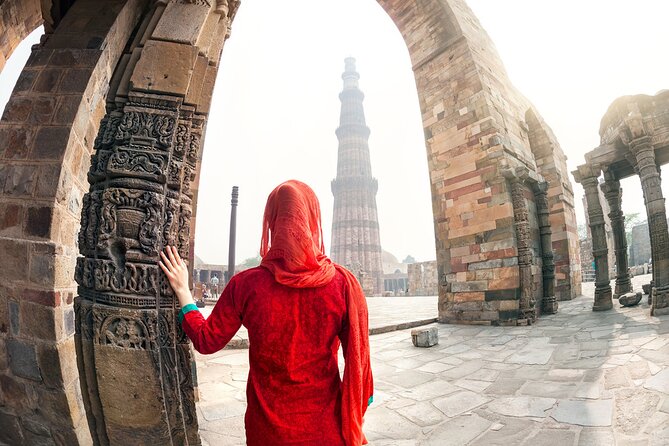
Later in the day you visit Qutub Minar, with about 45 minutes. It’s described as the tallest minaret built with bricks in 1192, and it sits within the Qutub complex, part of a UNESCO World Heritage Site.
This is the kind of stop that rewards even a short visit. The minaret’s height and the surrounding complex help you feel Delhi’s deep architectural timeline, from medieval era design to later layers of urban history.
Practical advice: wear shoes you can walk in. Qutub complex areas involve standing, viewing, and moving between vantage points.
Raj Ghat (optional): Gandhi’s memorial as a short pause
Raj Ghat is optional, with about 30 minutes. It’s dedicated to Mahatma Gandhi and is also connected to the name of a historic ghat in Old Delhi.
If you want a reflective stop in the middle-to-late part of the day, this can work well. If you’re more monument-focused and your feet are tired, skip it and keep your energy for Qutub and Lotus.
Lotus Temple: the last stop that often feels like a reset
You end with Lotus Temple, described as a Bahá’í House of Worship dedicated in December 1986, with a flower-like shape that has made it a major Delhi attraction. You’ll usually have about 1 hour here.
This is a great closing stop because it’s different from the fort-and-minaret style sights. It’s also a calmer way to wrap up your day—one last place where you can slow down, take photos, and get a final sense of modern Delhi’s spiritual architecture.
Driver and guide quality: what you can hope for (and what to watch)
The day lives or dies by the guide, and you’ll see big variation in guide performance in any Delhi sightseeing operation. The best outcomes show up when your guide is:
- Engaging and patient
- Able to explain significance clearly (not just read labels)
- Willing to adjust the route based on time and what’s busy
From the names tied to strong experiences (like Hersh, Parmajit, Karan, Faz, Pankaj Kumar, Satyam, Rahul, Danish, Jibran, and others), the most consistently praised theme is communication plus practical flexibility. Drivers like Vikram, Jeyul, Yogesh, and Tanvir are also noted for smooth driving through Delhi traffic, which matters because it affects whether you feel relaxed or worn out.
The caution: if your guide is light on explanations or sticks rigidly to a script, the day can feel like you’re just moving between stops. That’s one reason I recommend you choose this tour when you like having a guide answer questions.
Also, be aware that traffic can force schedule adjustments. If you rely on exact timing, message the team ahead and ask for a practical plan for your day.
Small comforts that actually matter in Delhi heat
Even if you don’t notice these at first, they add up:
- Complimentary water bottles and umbrellas help on hot or sun-heavy afternoons.
- The chauffeur car reduces time sitting in direct sun between stops.
- A private group pace means you’re less likely to feel rushed by strangers.
Delhi can hit extreme temperatures. If you’re traveling in summer, these “small” comforts become big ones.
Should you book this Old and New Delhi tour?
I’d book this if you want a guided, efficient day that covers the top Old Delhi and New Delhi landmarks without needing to plan every leg of the route yourself. It’s also a good fit if you want to experience the market side of Old Delhi through a tuk-tuk moment, not just from a car window.
I’d think twice if:
- You’re strict about a fixed timetable and can’t handle traffic-driven changes.
- You don’t want extra costs for the tuk-tuk ride or entrance ticket options.
- You prefer slow, deep museum-style touring rather than a highlight-driven circuit.
For most first-timers, though, this is a sensible way to get your bearings fast and see the city’s major architectural and cultural layers in one day.
FAQ
Is pickup from my Delhi hotel included?
Yes. The tour includes round-trip transfers from your Delhi hotel so you can start sightseeing without figuring out transport first.
How long is the tour?
It runs about 8 hours (approx.), with the pace set for your private group.
Is this tour private or shared?
It’s a private tour/activity. Only your group participates.
Are entrance tickets to monuments included?
Tickets to monuments are included if you choose the option with entrance fees. If you don’t choose that option, you may need to cover some entries yourself.
Is the tuk-tuk ride in Old Delhi included?
The tuk-tuk ride in Old Delhi is listed as not included, so you should confirm the exact cost for that segment with the provider before you go.
What happens if I visit on a Monday?
Akshardham is closed on Monday, so your plan switches to visiting Humayun’s Tomb instead.
Do I need to bring ID?
Yes. You should carry a valid photo ID for monument checking.