REVIEW · TOKYO
Official Street Go-Kart in Shibuya
Book on Viator →Operated by Street Kart · Bookable on Viator
Tokyo is more fun at street level. This small-group street go-kart tour sends you through Shibuya Crossing with folks waving and snapping photos, then rolls on toward Harajuku-area style and Omotesando streets. If you like turning a famous landmark into a memorable moment, this one hits that nerve.
What I really like is how personal it feels: the tour is capped at six people, so you’re not lost in a crowd. And the operation seems built for first-timers—clear safety setup, instructions, and a lead guide in the kart (people even namecheck guides like Michael and Manuel as especially good at keeping the ride smooth and safe).
One consideration before you book: you must have the right driving documents in hand. The International Driving Permit requirement means this is not a last-minute activity for most visitors. Plan ahead and you’ll be fine; winging it will be stressful.
In This Review
- Quick, worth-knowing highlights
- Price and value: what $76.27 really buys you
- Where you meet and how long the ride takes
- Before you drive: documents, fitness, and footwear
- The check-in vibe: what happens right at the shop
- On-kart safety and instructions: how they keep the ride fun
- Stop 1: cruising through Shibuya Crossing without losing the moment
- Stop 2: Harajuku style and atmosphere
- Stop 3: Omotesando streets, trees, and seasonal lighting
- Costumes: fun on top of the fun (with one important rule)
- Photos and keepsakes: the end-of-ride memory
- Group size (six) and what it means for your experience
- The big “will I like it?” checklist
- Booking timing: morning to night is really about your comfort
- Weather and how it affects your plans
- Who should book Street Kart Shibuya
- Should you book this go-kart tour in Shibuya?
- FAQ
- Do I need an International Driving Permit to drive in Japan?
- Can I use my home-country driver’s license instead of an IDP?
- What countries are exceptions or special cases for the IDP requirement?
- Is there a minimum age to drive?
- Can children or non-drivers ride along as passengers?
- How long is the tour?
- What footwear should I wear?
- Is hotel pickup included?
- Are costumes provided, and are there restrictions?
- Is insurance included?
- What happens if the weather is poor?
Quick, worth-knowing highlights
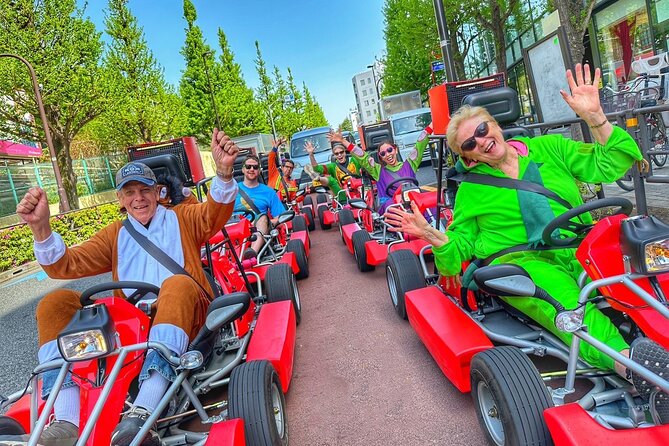
- A celebrity moment at Shibuya Crossing: You drive through the area where people stop and take photos.
- Small group cap of six: Easier control, tighter pacing, and more attention from your guide.
- Costumes are part of the fun: You’ll get a costume rental, adding big “this is ridiculous in the best way” energy.
- Safety gear and instruction included: You get guidance before you’re sent into Tokyo traffic.
- Harajuku + Omotesando routing: Fashion-and-luxury streets show up after the Shibuya excitement.
- Plan for the driving paperwork: You’ll need the correct IDP setup and a physical passport.
Price and value: what $76.27 really buys you
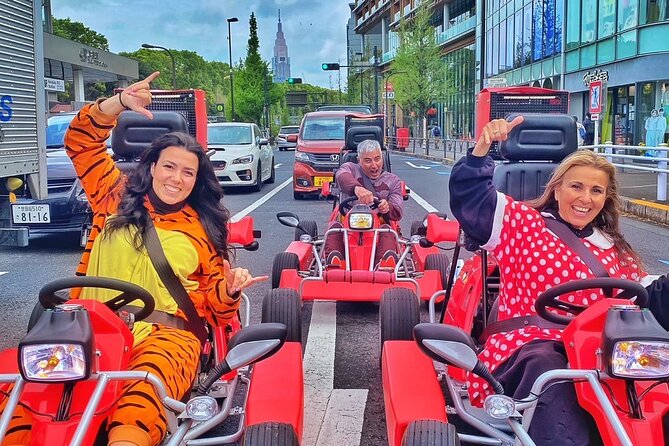
At about $76.27 per person, this is not the cheapest way to “do Tokyo.” But for what you’re getting—a guided kart ride in central Shibuya, costume rental, fuel, and safety equipment—it often lands in the “worth it” category for people who want one big, playful highlight.
Here’s why the value math makes sense for most visitors:
- You’re paying for an organized, guided route in a place that’s famous and chaotic.
- The cost includes things that would otherwise add up (taxes/fees, kart rental, costume rental, and fuel).
- The group is small (max six), which usually means better control and fewer delays.
The main “value wobble” is that full coverage insurance is not included and there’s a separate fee (¥1,000 per person) if you want it. If you’re budget-tracking, decide on that before you go.
You can also read our reviews of more tours and experiences in Tokyo.
Where you meet and how long the ride takes
You’ll meet at STREET KART Shibuya, Street Kart Maruyama-Cho Shibuya-ku (Maruyamachō, Shibuya). The tour ends back at the same meeting point.
Time-wise, expect roughly 1 hour to 1 hour 30 minutes. That’s long enough to learn the kart, enjoy a route with multiple Tokyo neighborhoods, and still feel like you got your money’s worth. It’s also short enough that it works as a daytime or evening anchor—especially because Shibuya’s vibe changes dramatically from day to night.
Before you drive: documents, fitness, and footwear
This is an adult driving activity. You need to be 18+ and you need the required license setup.
Here’s the key rule you should not ignore:
- You need an International Driving Permit issued in the 1949 Geneva Convention format, plus your physical passport.
- Certain countries listed (Switzerland, Germany, France, Taiwan, Belgium, Monaco) have an exception that still requires additional handling (a Japanese translation via JAF is mentioned for those cases).
If you don’t fit those categories, you might not be allowed to drive even if you have a perfectly valid license at home. In plain terms: get the IDP sorted early.
Physical readiness is lighter than many “active” tours, but not zero. You should have a moderate physical fitness level, and you’ll want to be comfortable sitting and controlling the kart for the duration.
Footwear matters too:
- Wear flat, closed-toe shoes.
- Avoid long, flowing skirts or dresses (you’ll be moving in and around the kart).
The check-in vibe: what happens right at the shop
Right before you ride, expect a structured prep flow. People describe efficient check-in with safety video guidance and a backup safety briefing. Then the technicians handle the mechanical side—orienting you to the kart and getting you ready to go.
What I like about this kind of setup is that it reduces the “I’m scared and everyone’s watching” feeling. Even if you’re a nervous driver, the process is designed to get you confident quickly—one review specifically said after the first few minutes you feel comfortable driving on the streets.
On-kart safety and instructions: how they keep the ride fun
The tour isn’t just “here’s a kart, good luck.” You get:
- A lead guide in a kart
- Instructions and safety gear included
- A pacing system so the group stays together
From the feedback, the most praised guides tend to do two things well:
- They explain clearly and calmly, especially if someone is nervous at first.
- They communicate to the group so you don’t feel like you’re improvising in traffic.
People namecheck different guides (Alexis, Allan, Saleh, Pime, and more), and the common theme is safety-first coaching. One recurring detail: guides can be very good at timing and route choices so the ride feels smoother.

Stop 1: cruising through Shibuya Crossing without losing the moment
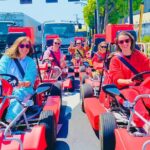
The first big wow is driving through the famous Shibuya Crossing area. The vibe here is pure spectacle: you’re moving, and the surrounding crowd’s attention is on you—people waving, smiling, and taking photos.
This stop matters because Shibuya is one of those places you can spend hours looking at from sidewalks, and it still won’t feel real until you experience it at street level. On a kart, you get a different angle, you move through the space, and the “where am I?” feeling turns into “I’m in the middle of Tokyo life.”
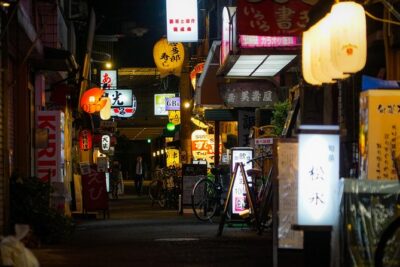
A practical note: if you’re sensitive to loud crowd energy, start time may affect how intense the moment feels. Night rides often feel more theatrical, while daytime can feel busier and noisier.
Stop 2: Harajuku style and atmosphere
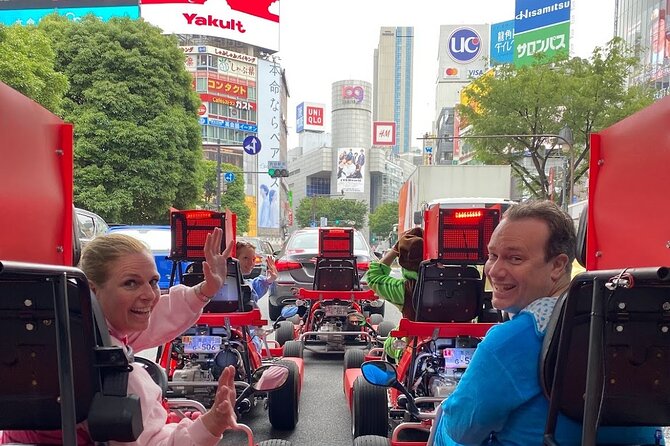
After Shibuya, the route shifts toward Harajuku, where the fashion identity of Tokyo gets visible fast. The tour frames Harajuku as the place where Tokyo fashion really starts—so you’ll see street-level style and a different atmosphere than Shibuya.
Why I think this stop is valuable: it gives contrast. Shibuya is the “global landmark” moment. Harajuku is where Tokyo’s youth culture and street style show up in motion—signage, storefront energy, and the feeling that everyone is styling themselves for the street.
This stop also keeps the ride from feeling like one long stunt. You get a rhythm: excitement, then texture, then another hit later.
Stop 3: Omotesando streets, trees, and seasonal lighting
From there, you head toward Omotesando, known for luxury shops and cafes—and in the evenings, the tree-lined boulevard can look especially good.
The tour notes that trees light up at night and offer different scenes by season. That’s a big deal for go-karting: you’re not just driving; you’re driving through a set of visual moods.
If you’re deciding between day and night, here’s a simple way to choose:
- Pick night if you want more lights and that “Tokyo at 9pm” energy.
- Pick day if you want clearer photos and you’re more comfortable managing street traffic in daylight.
Costumes: fun on top of the fun (with one important rule)
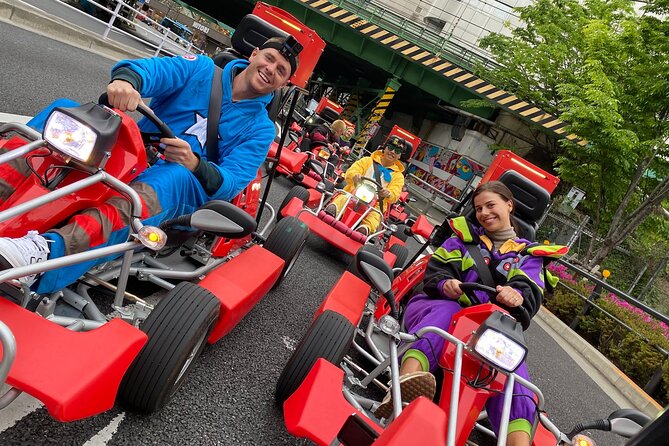
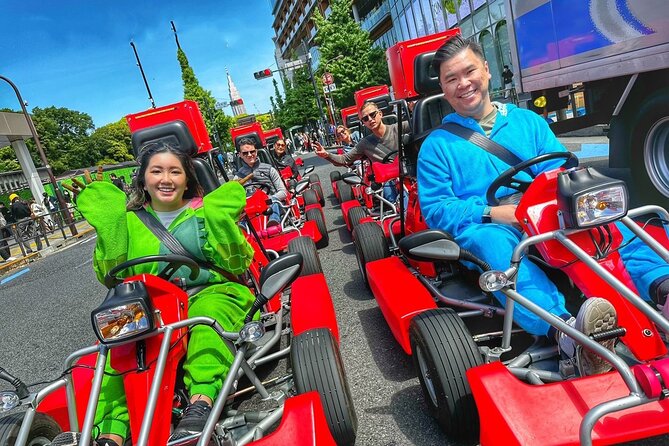
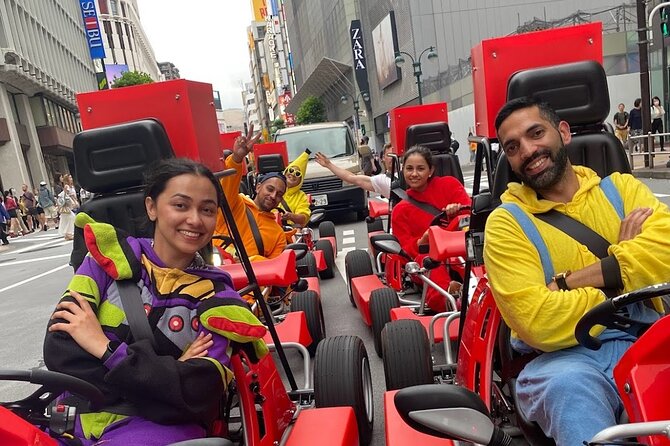
One of the most consistently praised parts is the costume rental. It’s not just a gimmick; it changes the vibe instantly. People describe multiple costumes and how the costumes add to the overall experience.
Two practical cautions:
- Your costume has rules. Mario/Nintendo-themed costumes are not allowed because of copyright restrictions.
- Dress for driving. Even if you choose something playful, you still need flat closed footwear and clothing that won’t tangle.
If you want to lean into the “celebrity” theme, costumes help you look the part for photos and make the crossing moment feel even more like a scene from a movie.
Photos and keepsakes: the end-of-ride memory
A lot of the positive feedback focuses on picture-taking. Guides take photos during the ride, and at least one review specifically mentions getting them via AirDrop right after the tour.
Even if you’re not a selfie person, do this for the simple reason that Shibuya moves fast and you won’t stop much while riding. Having a guide capture group shots means you’ll leave with a wearable memory, not just a blurry phone video.
Group size (six) and what it means for your experience
With a maximum of six travelers, you get two advantages:
- You stay closer together, so the ride feels coordinated rather than chaotic.
- Your guide can spend more time checking in with you as you learn the kart.
If you’re in a larger booking group, the note says the group will split into two smaller groups with a guide leading each group. That’s actually a good thing for safety and flow—just be aware you might not ride in the exact same micro-group.
The big “will I like it?” checklist
This tour fits best if you:
- Want one high-energy Tokyo highlight that’s more active than walking.
- Like photo moments and theater-level excitement at landmarks.
- Are comfortable with driving on busy streets after a short briefing.
- Have the IDP paperwork handled before you arrive.
You might not love it if:
- You hate the idea of doing driving paperwork in advance.
- You’re hoping for a purely sightseeing experience with zero driving stress.
- You show up without the correct documents. (The IDP rule is strict, and you have to carry physical proof.)
Booking timing: morning to night is really about your comfort
You can pick a start time from morning to night. That’s convenient, but it also shapes the feel:
- Night: more lighting, especially around Omotesando tree areas, and a more cinematic Shibuya vibe.
- Day: easier visibility and generally less temperature shock.
Also, wear something you can handle. Reviews mention winter and cold/rain scenarios. Costumes can help with rain and warmth, but you’ll still want layers under them so you’re not miserable.
Weather and how it affects your plans
This experience requires good weather. If it’s canceled due to poor weather, you’ll be offered a different date or a full refund.
So, if your trip is tight and your schedule is fixed, don’t place this tour on your last day unless you’re okay with a reschedule.
Who should book Street Kart Shibuya
This is a great match for:
- First-time visitors who want a signature Shibuya experience beyond standing around.
- Couples and small friend groups who want something different from standard tours.
- People who enjoy learning a skill for an hour and then using it immediately in a famous setting.
- Anyone who wants costumes without having to figure out logistics—your rental is part of the plan.
It can also work well for older participants, since feedback mentions someone riding even at age 74, and that the kart was reasonably comfortable and easy to drive.
Should you book this go-kart tour in Shibuya?
If you want a Tokyo highlight that feels playful, photo-ready, and guided end-to-end, I’d say yes, especially if you’re already excited by the idea of driving through Shibuya Crossing while wearing a costume.
The decision mainly comes down to two questions:
- Can you get the required International Driving Permit correctly and in time for Japan?
- Are you okay with the fact that this is a real driving activity, not just a guided walk?
If both are true, you’re likely to love it. It’s the kind of activity that turns a crowded famous area into a personal, street-level memory.
FAQ
Do I need an International Driving Permit to drive in Japan?
Yes. You’ll need an International Driving Permit issued in the format of the 1949 Geneva Convention. You also must carry your physical International Driving Permit (and physical passport). Some listed countries have extra requirements, such as obtaining a Japanese translation from JAF.
Can I use my home-country driver’s license instead of an IDP?
No. A special document is required. The instructions explain that you need the International Driving Permit rules described in the Additional Info.
What countries are exceptions or special cases for the IDP requirement?
The provided info lists Switzerland, Germany, France, Taiwan, Belgium, and Monaco as exceptions. It also says those participants may need to obtain a Japanese translation via JAF.
Is there a minimum age to drive?
Yes. The minimum age is 18 years.
Can children or non-drivers ride along as passengers?
No. The karts are single-seaters, and all participants must be 18+ and hold a valid driver’s license in Japan.
How long is the tour?
The duration is approximately 1 hour to 1 hour 30 minutes.
What footwear should I wear?
Wear flat, closed footwear. Avoid no long flowy skirts or dresses.
Is hotel pickup included?
No. Hotel pickup and drop-off are not included, and the activity ends back at the meeting point.
Are costumes provided, and are there restrictions?
Costumes are included via costume rental. Mario- or Nintendo-themed costumes, and items suggesting those characters, are not permitted.
Is insurance included?
No. Full coverage insurance is not included, and there is an additional fee of ¥1,000 per person if you want it.
What happens if the weather is poor?
The experience requires good weather. If it’s canceled due to poor weather, you’ll be offered a different date or a full refund.