REVIEW · SEOUL
Seoul moonlight walking tour with local historian
Book on Viator →Operated by SeoulDude's Walking tours · Bookable on Viator
Night Seoul feels different when you walk. This moonlight route turns a simple stroll into stories about daily life, the capital’s past, and skyline lights.
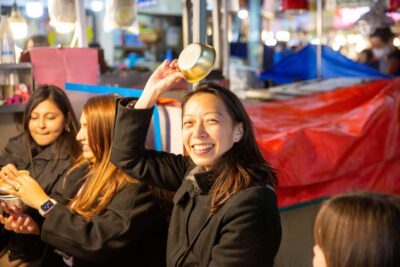
I love the small-group feel (up to 20 people) and the way guides like Jessica and Ethan mix history with humor.
One thing to plan for: plenty of uphill stairs in the evening, so comfy shoes matter.
In This Review
- Key Highlights to Know
- A 2-Hour Moonlight Route Starting in Hyehwa
- Stop 1: Seoul University Hospital Medical Museum Culture After Dark
- Stop 2: Marronnier Park and the Performing-Arts Seoul
- Stop 3: Naksan Park, Capital Changes, and Hanyang City Wall
- Stop 4: Ihwa Mural Village and the Stories of the Hillside Homes
- Stop 5: Seoul City Wall at Night for the Skyline Finale
- Price and Value: Why It Costs $31.98 and What You Get
- What You Should Bring for a Night with Stairs and City Lights
- Who This Tour Fits Best (and Who Might Find It Tough)
- Should You Book This Moonlight Walk?
- FAQ
- How long is the Seoul moonlight walking tour?
- Where is the meeting point?
- Does it end at the same place?
- What is the price per person?
- Is a mobile ticket used?
- Is dinner included?
- Are there admission fees for the stops?
- How big is the group?
- Does the tour depend on weather?
- Can I cancel for free?
Key Highlights to Know
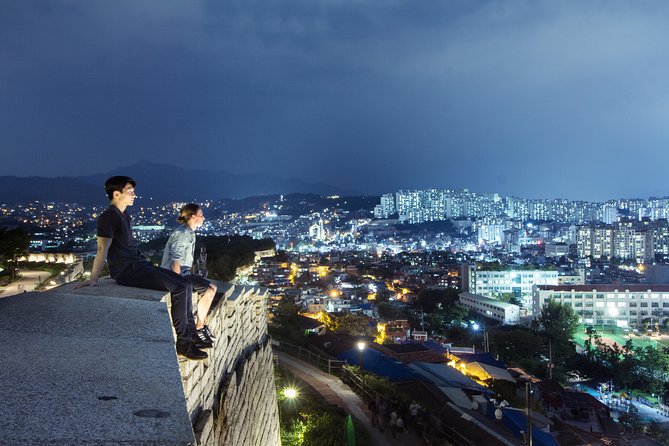
- City wall night views: you end with some of the best Seoul light views from the hilltop.
- Free-entry stops: the scheduled museum and parks listed on the route don’t require admission fees.
- Historian-led pacing: questions get answered, and the group stays small (max 20).
- Unfussy, real Seoul neighborhoods: you pass through areas foreigners often miss.
- Guides bring personality: names like Jessica, Ethan, Leah, and June come up often for funny, clear storytelling.
- Stairs are part of the deal: expect uphill walking and steps for sunset-to-night scenery.
A 2-Hour Moonlight Route Starting in Hyehwa
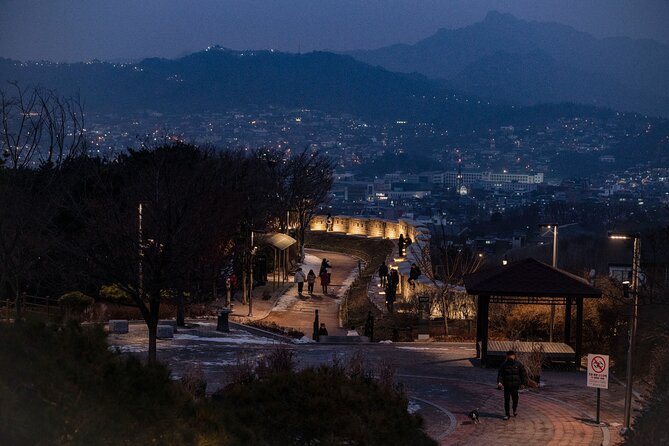
This tour is built for an easy evening plan: about 2 hours total, starting and ending at the same spot near Hyehwa (120 Daehak-ro, Jongno District). You’ll walk at a pace that lets you hear stories, pause for photos, and still make it to the hilltop views before the night sky settles in.
I like the time window here because it fits almost any Seoul day. You can do this early in your trip to get your bearings fast, or later as a low-stress way to see neighborhoods beyond the main subway circuit. The route also uses mobile tickets, which keeps things simple once you’re there.
The biggest practical point is that the walk includes uphill climbs and stairs. Most people find it manageable, but you should treat it like “night walking plus steps,” not a flat city stroll.
You can also read our reviews of more tours and experiences in Seoul.
Stop 1: Seoul University Hospital Medical Museum Culture After Dark
You begin at Seoul University Hospital Medical Museum. It’s described as the highest place students can reach in Korea, with time to learn about “weird, but unique” university culture in the country. That opening stop matters because it sets the tone: you’re not just chasing views. You’re learning how Korean society thinks about education, institutions, and status.
This stop also has a nice added value: it’s listed as free admission, so you’re not forced to guess whether entry fees will add up. The time here is short (about 10 minutes), which works well for an evening tour. You get context without burning your whole night indoors.
Potential drawback: if you’re hoping for a big museum visit, this isn’t that kind of tour. It’s more of a quick orientation stop where the guide uses the museum setting to explain bigger cultural ideas.
Stop 2: Marronnier Park and the Performing-Arts Seoul
Next comes Marronnier Park, set up as a cultural area famous for live theaters and live shows. This is the “you’re in the real city now” moment. Even when you’re not watching a performance, the area’s energy and purpose help explain why Seoul feels different at night—music, venues, and street life all move together.
This stop is brief (about 5 minutes), so it’s not meant to become your dinner plan. It’s more like a window into the kinds of nights locals go out for. If you like art districts, or you want a little cultural flavor before heading toward the hills, this short stop does its job.
One consideration: since it’s short, you’ll get the most from it if you’re ready to listen and look at details right away.
Stop 3: Naksan Park, Capital Changes, and Hanyang City Wall
The route then shifts into the big historical theme at Naksan Park. Here, the guide connects Seoul’s geography to its history by explaining how Korea’s capital location developed and how it changed over time. That makes the walk feel purposeful. You’re not just climbing for views—you’re learning why these hills and walls matter.
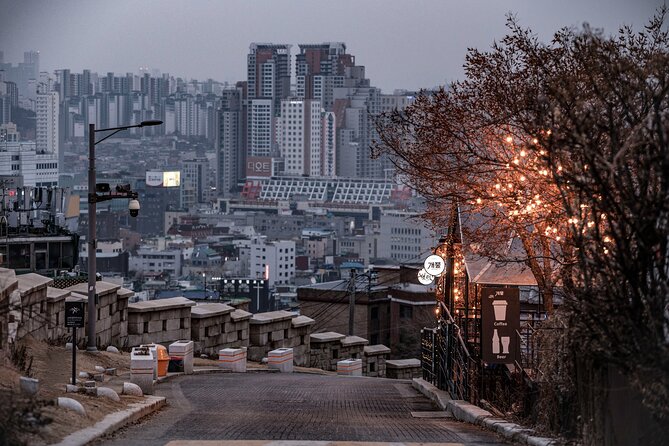
Time here is around 10 minutes, and it leads you toward the area connected to Hanyang City Wall, described as a historical monument with excellent night scenery. The tour framing also notes the city wall area is famous for night views, including pop-culture references such as K-pop Demon Hunters.
This segment is also where your “stairs brain” should kick in. People often focus on the final skyline payoff, but it’s the climb itself that sets you up for that payoff. If you tend to get winded, slow your pace early and let the guide’s rhythm do the work.
Practical upside: the tour’s theme helps you look at the city wall differently. Instead of seeing it as just a photo spot, you’ll start noticing the logic of the walls and the viewpoint relationship to the city below.
Stop 4: Ihwa Mural Village and the Stories of the Hillside Homes
After the park, you’ll head to Ihwa Mural Village (about 20 minutes). This is a mural area, yes, but the tour approach is more social than decorative. The description frames it as a village of unwealthy people, explaining that many hillside villages in this area were home to people with fewer resources. The guide’s goal is to help you read the place as a story, not only a backdrop.
I like this kind of framing because it prevents the usual tourist trap: seeing murals as “cute” and moving on. Here, you’re encouraged to connect the art to the living history of the hillside and what “life on a hill” meant in real terms.
You’ll get enough time for photos and wandering through the mood of the lane ways, but it still stays inside the tour’s overall 2-hour flow. If you’re someone who likes to take your time, you may want to slow down during this stop and let the guide’s stories land.
Possible drawback: because the neighborhood is on hills, you’ll keep dealing with steps and elevation. The murals are worth it, but you’ll feel the terrain more here than earlier stops.



Stop 5: Seoul City Wall at Night for the Skyline Finale
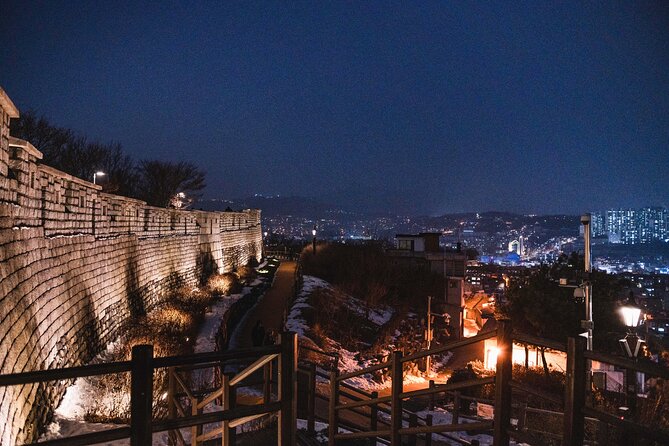
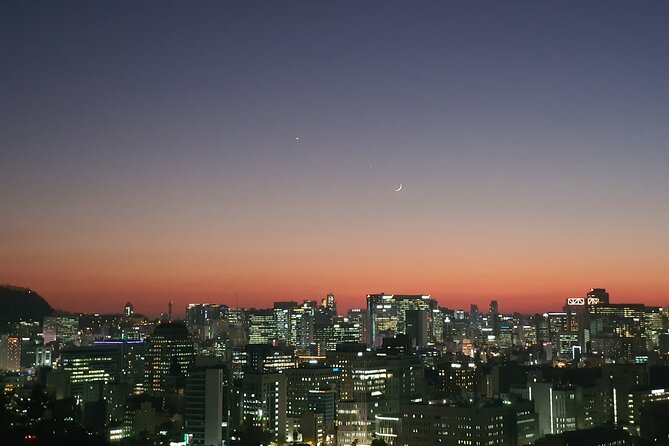
The final major stop is the Seoul City Wall, described as a historical monument with romantic atmospheres and some of the best night views. The tour calls it hidden but “the best place” for night views of Seoul, and the walk style matches that promise: the further you go up, the more city lights start to fill your field of view.
Time here is about 20 minutes, which is enough to grab photos and still hear the guide’s explanation of the scene you’re looking at. This is where the evening clicks. You’ll get that layered Seoul look: dark sky, warm lights, and the wall forming a frame behind everything.
One more detail I found useful from the tour tips shared in feedback: you really do want your phone ready. Fully charged, camera app open, and a plan for quick shots saves time. Also, a bug-spray tip comes up, which makes sense once you’re outdoors longer in the evening.
If you’re sensitive to heights or steep areas, keep your expectations realistic. The climb is part of the night-view package.
Price and Value: Why It Costs $31.98 and What You Get
At $31.98 per person for about 2 hours, this tour sits in a price band that makes sense for a paid-guided experience. Here’s the value logic that helps you decide:
- The stops listed have free admission for you (including the medical museum and the other scheduled places).
- You’re paying for the route, the local historian storytelling, and the fact that you’re guided to viewpoints you might not find on your own.
- The pacing is set up for night lighting and photos, not just walking from A to B.
So you’re not paying for entrance fees. You’re paying for interpretation. And based on the recurring guide names in feedback (Jessica, Ethan, Leah, June, Smin/Sumin), the “interpretation” part is what people most often praise: humor, clarity, and the way the guide connects today’s Seoul to older systems and social realities.
If you’re the kind of traveler who enjoys learning while moving, this price is a fair bet. If you only want scenery and would rather skip explanations, you might feel the cost more than someone who’s there to learn.
What You Should Bring for a Night with Stairs and City Lights
Even though the tour says no special supplies are needed, a few practical items can make the experience much easier:
- Comfy shoes: multiple stops build in uphill walking and stairs.
- A charged phone: night views and city wall angles mean you’ll want photos ready fast.
- Bug spray: one repeated tip is to bring it.
- Weather awareness: the tour requires good weather. If it’s canceled due to poor conditions, you should expect a different date or a full refund.
Also, dress for nighttime temps and uneven ground. Some parts of the route feel more like hillside paths than flat sidewalks. You don’t need hiking gear, but you do want stable footing.
Who This Tour Fits Best (and Who Might Find It Tough)
This one is a strong match if you want Seoul with context. You’ll get a mix of:
- university culture explanations at the medical museum stop,
- the performing-arts vibe at Marronnier Park,
- capital and city-wall history at Naksan Park,
- and the hillside social story at Ihwa Mural Village,
all wrapped up with night views from the wall.
It also fits people who like meeting others in a small group. With a cap of 20 people, the tour doesn’t feel crowded. Solo visitors can also like this because you’re moving and learning with an easy structure.
The main group that should think twice: anyone who doesn’t want stairs at night. Even though many people say the walk is manageable, it’s still an uphill and steps-style route. If that’s a dealbreaker, you might prefer a flatter night option.
One more balanced note: there’s at least one mixed experience tied to guide communication and storytelling smoothness. That can happen with any tour. If you’re very sensitive to language flow, consider picking a date when you expect strong guide communication, and keep your expectations flexible.
Should You Book This Moonlight Walk?
I’d book this tour if you want an evening that’s more than pictures. The best part is the combination: you climb into the Seoul City Wall views while a local historian explains why these places matter socially and historically.
Book it if you:
- enjoy hearing cultural stories while you walk,
- want free-entry stops plus a guide-driven route,
- and can handle uphill steps in the dark.
Skip it (or reconsider) if:
- stairs make you uncomfortable,
- you’re mainly looking for a flat night sightseeing loop,
- or you’d rather pay for a single attraction than invest in a full 2-hour guided circuit.
If your goal is to understand Seoul from the inside, this is a solid way to do it without wasting your night on guesswork.
FAQ
How long is the Seoul moonlight walking tour?
It runs for about 2 hours.
Where is the meeting point?
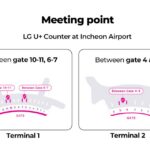
The tour starts at Hyehwa 120 Daehak-ro, Jongno District, Seoul, South Korea.
Does it end at the same place?
Yes. It ends back at the meeting point.
What is the price per person?
The price is $31.98 per person.
Is a mobile ticket used?
Yes, it uses a mobile ticket.
Is dinner included?
No. There is an optional food session after the tour, but the fee is not included.
Are there admission fees for the stops?
The listed stops include free admission tickets, including the Medical Museum and the other scheduled stops.
How big is the group?
The group size is capped at a maximum of 20 people.
Does the tour depend on weather?
Yes. It requires good weather. If it’s canceled due to poor weather, you’ll be offered a different date or a full refund.
Can I cancel for free?
Yes. Free cancellation is available up to 24 hours before the experience start time for a full refund.